
An online return policy is the set of rules a store publishes about how long you have to send something back, who pays for shipping, and how you get your money back. If you’re shopping, the one thing to check before you click “buy” is the return window and who covers return shipping. If you’re running a store, the one thing to fix today is publishing that same information somewhere a customer can find it in under ten seconds.
Here’s what to check as a shopper:
- Return window (30 days is standard, but some brands cut it to 14 or extend it to 90).
- Who pays for shipping the item back.
- Whether you get a refund, store credit, or exchange only.
- Exceptions for the exact item you’re buying (final sale, opened packaging, worn items).
Here’s what to publish as a retailer:
- A clearly stated return window with a plain rule for when the clock starts.
- Who pays return shipping and under what conditions.
- Item condition requirements and any category exceptions.
- A visible link to the full policy from the product page, cart, and checkout.
The FTC requires sellers to ship within 30 days when no date is promised, and shoppers who don’t get their order have the right to dispute the charge. Retailers who want a working example of clear return language can look at how SavyCart structures its own shipping and return policy for product-page placement ideas. Jump ahead for the consumer checklist or the retailer templates if you already know which side of this you’re on.
Key Takeaways
Clear, prominently placed return terms reduce cart abandonment for retailers and cut refund disputes for consumers more effectively than strict eligibility rules do.
| Point | Details |
|---|---|
| Check the window first | As a shopper, confirm the return period and who pays shipping before you buy, not after. |
| Publish policy everywhere | Retailers should link the full policy on product pages, cart, checkout, and confirmation emails. |
| Pick a template that fits your margin | Lenient, balanced, and strict templates each trade conversion for cost control differently. |
| Track return reasons, not just rates | Return reason distribution and cost per return reveal which SKUs need better product pages. |
| Keep your documentation | Save order confirmations and tracking numbers in case you need to dispute a delayed refund. |
| SavyCart links policy at every step | Return and shipping terms appear on product pages and order confirmations, backed by shipment tracking. |
Table of Contents
- What Is an Online Return Policy, and Why Does It Matter?
- What Should Every Online Return Policy Include?
- How Do You Write a Return Policy That Actually Works?
- How Can You Reduce Return Rates Without Hurting Sales?
- What Are Your Rights If a Refund Is Delayed or Denied?
- What Should You Know About Cross-Border Returns and Taxes?
- Frequently Asked Questions
- Sources
What Is an Online Return Policy, and Why Does It Matter?
An online return policy is the published rulebook for sending a purchase back. A refund policy is narrower. It only covers how and when money comes back to you once a return is approved. Most stores fold both into one document, but they’re answering different questions: one is about eligibility, the other is about payment.
The stakes are higher than most shoppers realize. Reverse logistics (the process of getting a returned item back into inventory or disposed of properly) now eats into margins across nearly every ecommerce category, and ecommerce sales volume climbed sharply during the pandemic, dragging return volume up right along with it. A vague or hidden policy doesn’t just annoy customers. It drives cart abandonment before checkout even starts.
Shoppers have caught on. Survey data on return policy characteristics that discourage purchases shows that unclear or restrictive terms are among the top reasons people back out of a sale entirely. That single data point should reframe how retailers think about the policy page: it’s not legal boilerplate, it’s a conversion tool.
The two sides want different things, and a good policy finds the middle:
- Merchants want to protect margin, cut fraud, and keep processing costs predictable.
- Consumers want a fast, low-friction refund with no surprise fees or shipping costs sprung on them after the sale.
What Should Every Online Return Policy Include?
A policy that leaves gaps invites confused emails and chargebacks. Every version, whether it’s three sentences or three pages, needs the same core elements.
- Scope and eligible items. State plainly what can and can’t be returned. “All items except final-sale clearance and opened personal care products are eligible for return.”
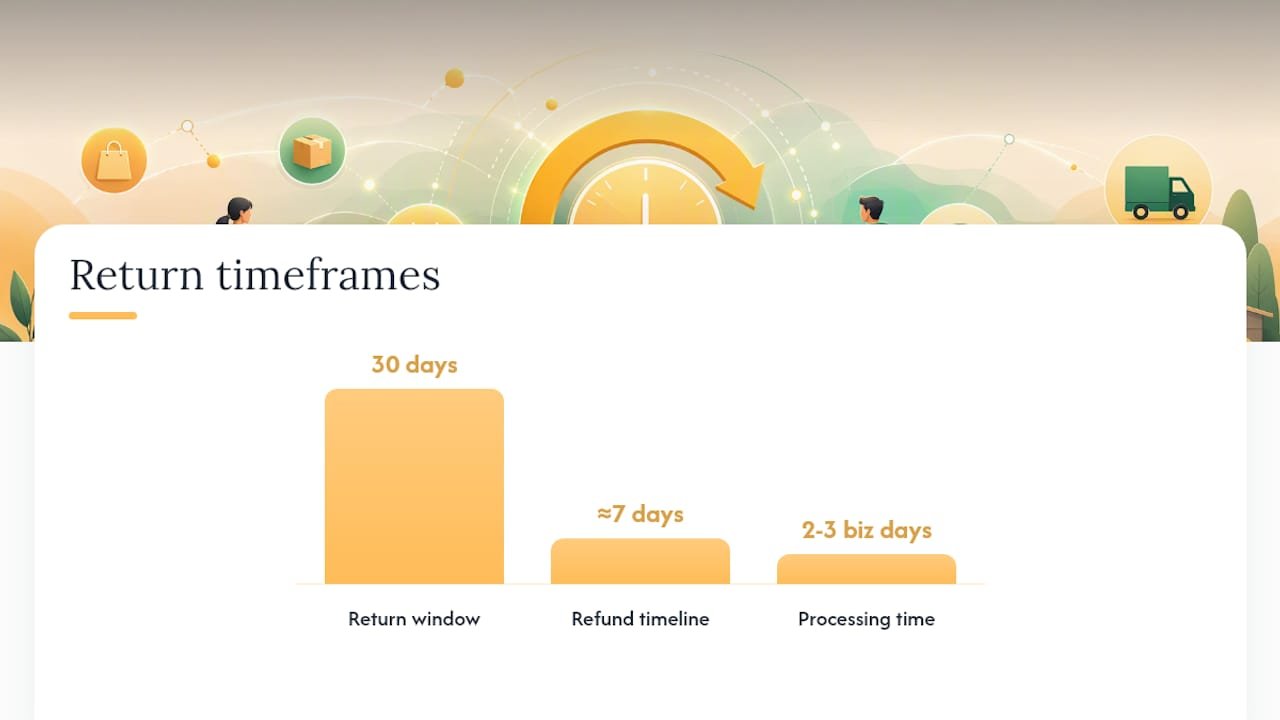
- Return window and start date. Specify when the clock starts. “You have 30 days from the delivery date to initiate a return.”
- Item condition. Set the bar for what counts as returnable. “Items must be unworn, unwashed, and include original tags.”
- Proof of purchase. Name what you’ll accept. “A copy of your order confirmation email or order number is required.”
- Return shipping responsibility. Say who pays, without hedging. “We provide a free prepaid return label for U.S. orders.”
- Refund method and timeline. Give a number. “Refunds are usually issued to your original payment method within about a week after receiving the return.”
- Exchanges vs. store credit. Clarify the options. “You may choose a refund, exchange, or store credit at checkout of your return.”
- Restocking fees and exceptions. Flag anything narrow. “Electronics returned without original packaging are subject to a 15% restocking fee.”
- Processing timeline. Set expectations once the item arrives. “Allow 2 to 3 business days for us to inspect and process your return.”
- Contact channel. Name a real way to reach someone. “Email returns@yourstore.com with your order number for return assistance.”
Placement matters as much as content. Link the full policy in the site footer, on every product page near the “add to cart” button, in the cart summary, and again in the order confirmation email. Burying it on a standalone page nobody visits defeats the purpose.
Pro Tip: Put the return window in bold, oversized text right on the product page for anything with sizing risk, like clothing or shoes. Shoppers scan for that number before reading anything else.
How Do You Write a Return Policy That Actually Works?
Writing the policy is the easy part. Getting it into the right places, tested against real customer behavior, is where most retailers stall out.
- Define your objective. Decide whether you’re optimizing for conversion (lenient terms) or margin protection (stricter terms).
- Pick a return window. 30 days is the default across most of ecommerce; go shorter only if you sell perishables or fast-depreciating tech.
- Set shipping rules. Decide if returns are free, flat-fee, or deducted from the refund.
- Choose refund types. Refund to original payment, store credit, or exchange only, and be explicit about which categories get which option.
- Write the copy in plain language. Avoid legal jargon; a ninth-grader should be able to follow it on the first read.
- Run a legal check. Confirm compliance with your operating region’s consumer protection rules before publishing.
- Publish and link it everywhere. Footer, product pages, cart, checkout, and confirmation emails.
- Add post-purchase reminders. A follow-up email restating the window nudges customers toward faster action.
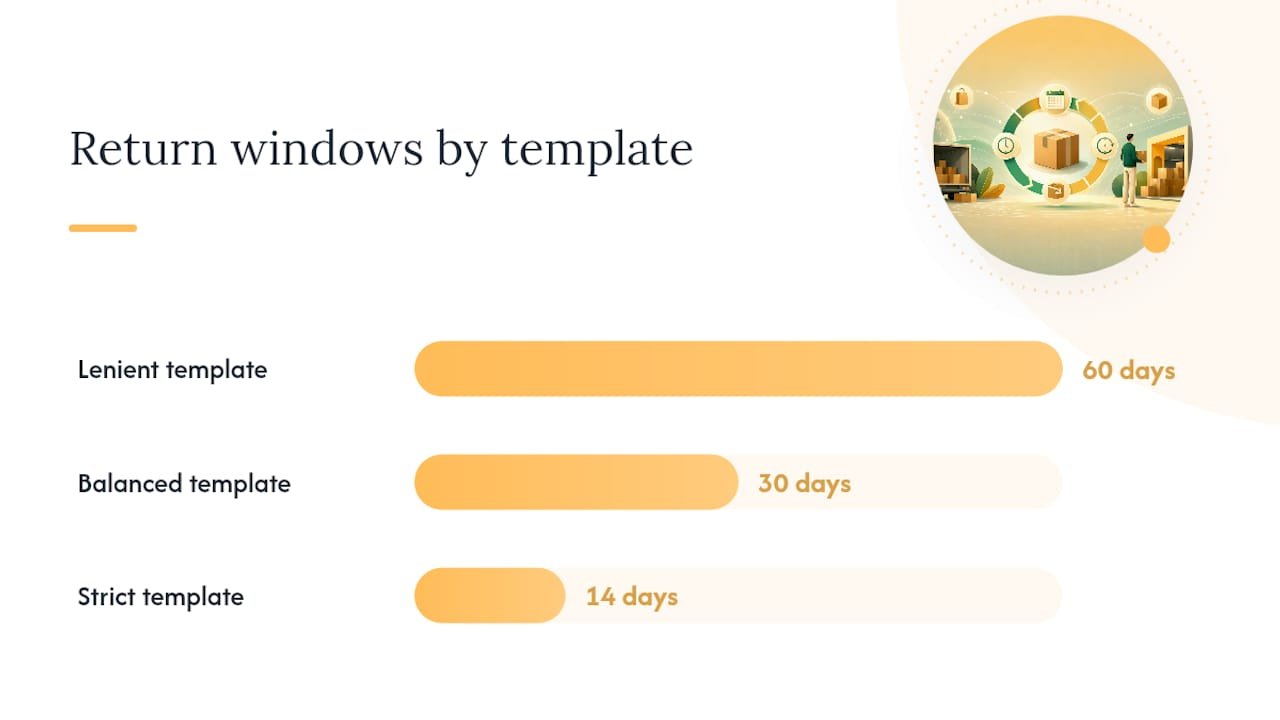
Three starting templates, adaptable to your margins and category:
- Lenient: “Return any item within 60 days for a full refund. We cover return shipping on all U.S. orders, no questions asked.”
- Balanced: “Returns accepted within 30 days of delivery for unworn, unused items with tags attached. Customers cover return shipping unless the item arrived damaged or incorrect.”
- Strict: “Returns accepted within 14 days for store credit only. Items must be unopened and in original packaging. Final sale items, including clearance and personalized products, are not eligible.”
For hosting and mechanics, ecommerce platforms like WooCommerce offer built-in return and refund tooling that generates return labels and tracks status automatically, which saves a lot of manual back-and-forth once volume picks up.
Pro Tip: After publishing, watch your support inbox for the first two weeks. A spike in “what counts as returnable” questions means your policy language isn’t as plain as you think it is.
How Can You Reduce Return Rates Without Hurting Sales?
Most returns trace back to one root cause: the customer didn’t know what they were buying until it arrived. Fixing that upstream, on the product page, cuts returns more effectively than tightening the policy after the fact.
- Add detailed measurements, multiple angle photos, and short video demos for anything size- or fit-dependent.
- Build a size guide with real customer measurements, not just generic S/M/L charts.
- Offer virtual try-on tools where the category supports it (apparel, eyewear, furniture).
- Answer fit and function questions directly in a pre-purchase FAQ block on the product page.
- Nudge customers toward exchanges over refunds with a small incentive, like a $5 credit for choosing exchange.
- Reserve free returns for loyalty members and charge a modest fee for one-time shoppers on high-return categories.
Retailers who get this right are already blending customer experience with fraud control: balanced return policies that pair one free-return option with targeted safeguards, like return authorizations for flagged accounts, tend to hold conversion steady while keeping abuse in check.
Tracking the right numbers tells you where the leaks are:
| Metric | What It Tells You |
|---|---|
| Return rate by SKU | Flags specific products with sizing or quality problems. |
| Return reason distribution | Shows whether returns are driven by fit, damage, or buyer’s remorse. |
| Average cost per return | Reveals the true margin hit once shipping and processing are counted. |
| Refund lag days | Measures how fast customers actually get their money back. |
| Repeat returner rate | Highlights accounts worth flagging for manual review. |
A Transport Policy journal study on the logistical costs of returns found that operational interventions upstream, like better sizing information, reduce needless reverse-shipping trips more reliably than punitive return terms do.
Pro Tip: Send a status update at each stage: received, inspected, refund issued. Customers who hear nothing for five days assume the return failed, even when it’s processing normally.
What Are Your Rights If a Refund Is Delayed or Denied?
Consumers have more leverage than most realize, especially once a payment method gets involved. The FTC’s guidance on online purchases lays out the baseline: sellers must ship within 30 days if no date was promised, and buyers can dispute charges for items that never arrive or don’t match what was described.
If your return or refund stalls, work through these steps in order:
- Save your documentation. Order confirmation, tracking number, and photos of the item’s condition before you shipped it back.
- Contact the seller directly. Reference the specific policy terms and your order number.
- Recheck the published policy. Confirm the timeline you were promised versus what’s actually happened.
- Escalate to your card issuer. File a dispute if the seller doesn’t respond or refuses a refund you’re entitled to under their own stated terms.
The FTC advises that if you never receive an item you paid for, or it doesn’t match the seller’s description, you have the right to dispute the charge with your credit card company. Keeping your order records and shipping confirmations is what makes that dispute go smoothly instead of dragging out.
What Should You Know About Cross-Border Returns and Taxes?
International returns cost more and take longer, full stop. Customs duties, VAT, and international return shipping stack on top of the base cost, and a return that takes 5 days domestically can take three weeks once it crosses a border. Where possible, offer local drop-off points or regional return centers instead of forcing every international customer to ship back to your home warehouse.
Statutory return rights also aren’t uniform. EU consumers, for instance, have baseline withdrawal rights that don’t automatically apply to shoppers in other regions, so any country-specific exception needs its own clear line in the policy rather than a one-size-fits-all clause.
Tax handling adds another layer. Sales tax practitioners note that returns complicate multi-jurisdiction tax reporting, since refunding the item without correctly reversing the tax charged creates reconciliation headaches later. Spell out, in plain terms, whether taxes and duties are refunded and who’s responsible if they’re not.
Pro Tip: During the holiday season, temporarily extend or localize return options for your best-selling international SKUs. The volume spike is exactly when cross-border friction costs you the most goodwill.
Why SavyCart Treats Return Clarity as a Trust Issue, Not a Legal Formality
We’ve found that most return disputes come down to one thing: a customer who genuinely didn’t know what they were agreeing to at checkout. That’s why our shipping and return policy and refund policy are written in plain language and linked directly from every product page, not tucked away in a footer nobody clicks. Operationally, clear terms also mean fewer support tickets and faster resolutions on our end. We keep testing that language against real customer questions and adjust wording whenever a pattern of confusion shows up in support tickets.
How SavyCart Makes Returns Less of a Headache
Running a return smoothly comes down to three things: a policy customers can actually find, shipment visibility once the return is in transit, and a real person to reach when something goes wrong. SavyCart builds all three into the shopping experience, with return terms linked from every product page and order confirmation, plus shipment tracking that shows exactly where a return package is at any point in the process.
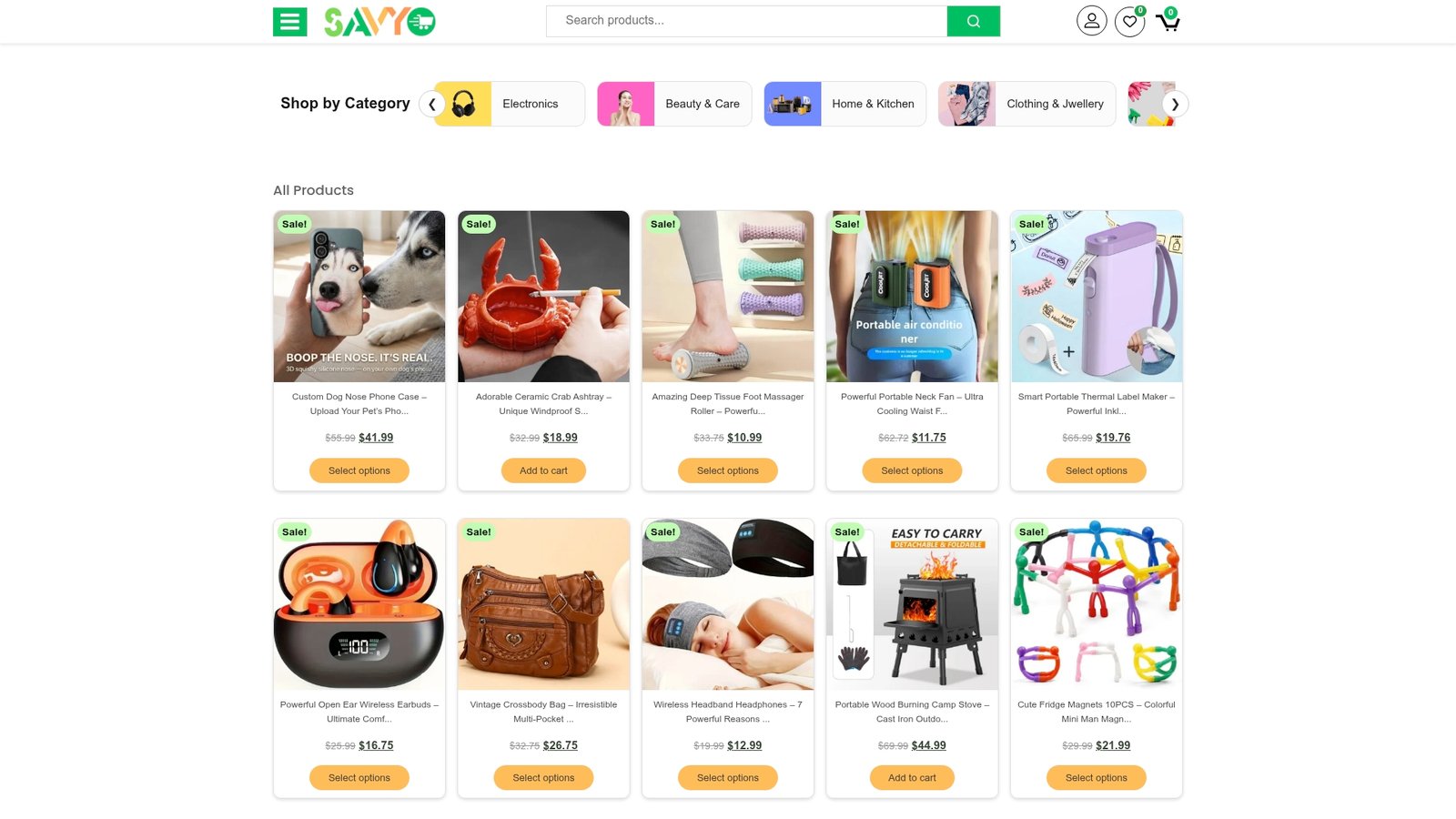
Full disclosure: SavyCart is the retailer here, not a neutral reviewer, but that’s exactly why we’ve put effort into making the return process something you don’t have to think twice about. If you’ve got an order in transit or a return in progress, check your shipment tracking status for the latest update, or reach out to customer service directly if something looks off.
Frequently Asked Questions
What is a reasonable return window for an online store?
Thirty days is the industry default, though categories like electronics often use 14 to 15 days and apparel sometimes extends to 60 or 90 days to build buyer confidence.
Who pays for return shipping on online purchases?
It varies by retailer. Some cover it fully as a customer-experience perk, others deduct a flat fee from the refund, and some charge full return shipping except when the item arrived damaged or wrong.
How long does a refund take after a return is received?
Most retailers process refunds within 5 to 7 business days of receiving the returned item, though the FTC’s shipping-timeline guidance applies more directly to the original shipment than the refund itself.
What should I do if a retailer won’t honor its own return policy?
Save your order confirmation and tracking records, contact the seller in writing referencing the specific policy terms, and dispute the charge with your card issuer if the seller doesn’t resolve it.
Do return policies differ for clothing versus electronics?
Yes. Apparel returns usually hinge on unworn condition and tags attached, while electronics often carry restocking fees and require original packaging because resale value drops sharply once a box is opened.